
Last reviewed: November 2026
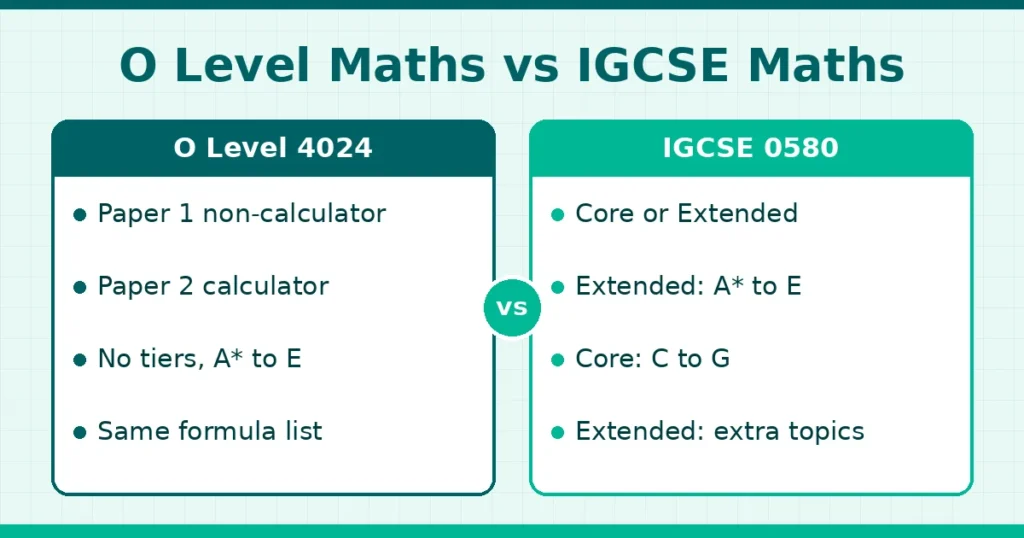
Quick answer: In the O Level Maths vs IGCSE Maths comparison, Cambridge says the two are equivalent qualifications, grade for grade. O Level Mathematics 4024 is very close to the Extended route of IGCSE Mathematics 0580. Both have a 2-hour non-calculator paper and a 2-hour calculator paper, each worth 100 marks. The main differences: 4024 has no Core/Extended tiers, and 0580 Extended includes a few extra topics, such as differentiation and exact trig values.
If your child’s school offers O Level, or you’re moving between schools, the O Level Maths vs IGCSE Maths question comes up quickly. The two course codes look different, and the names suggest different levels. In reality, they’re much closer than most parents expect. This matters for many families in Saudi Arabia, the UAE and Qatar, where some schools teach O Level and others teach IGCSE.
This guide compares 4024 vs 0580 side by side: papers, tiers, grades, topics and formula sheets, using Cambridge’s syllabuses for exams in 2025, 2026 and 2027. We’ll also cover what to do if your child is switching from O Level to IGCSE Maths.
Is O Level Equivalent to IGCSE?
Yes. Cambridge describes O Level as an internationally recognised qualification equivalent to Cambridge IGCSE and the UK GCSE, and says that Cambridge IGCSE and Cambridge O Level are equivalent qualifications grade for grade.
So an A in O Level Maths and an A in IGCSE Maths are meant to carry the same value. The differences are in how the course is set up, not in the level.
O Level Maths vs IGCSE Maths: The Papers Side by Side
| O Level Maths 4024 | IGCSE Maths 0580 Extended | IGCSE Maths 0580 Core | |
|---|---|---|---|
| Papers | Paper 1 and Paper 2 | Paper 2 and Paper 4 | Paper 1 and Paper 3 |
| Non-calculator paper | Paper 1: 2 hours, 100 marks, 50% | Paper 2: 2 hours, 100 marks, 50% | Paper 1: 1 h 30 min, 80 marks, 50% |
| Calculator paper | Paper 2: 2 hours, 100 marks, 50% | Paper 4: 2 hours, 100 marks, 50% | Paper 3: 1 h 30 min, 80 marks, 50% |
| Tiers | None: everyone sits the same papers | Extended tier | Core tier |
| Grades available | A* to E | A* to E | C to G |
| Formula list on page 2 | Yes | Yes | Yes (shorter list) |
The paper numbers can be confusing. In O Level, Paper 1 is the non-calculator paper. In IGCSE Extended, the non-calculator paper is Paper 2. Students moving between the two should check which is which before they start past papers.
Apart from the numbering, the O Level papers and the IGCSE Extended papers look very similar. Both use structured and unstructured questions. Both give the same approximate weight to skills: 40–50% for knowledge and understanding of mathematical techniques, and 50–60% for analysing, interpreting and communicating mathematically. The answer rules are the same too: non-exact answers to 3 significant figures, angles to 1 decimal place, and π from the calculator or 3.142. To see how the two IGCSE Extended papers compare, read our guide to 0580 Paper 2 vs Paper 4.
Tiers: The Biggest Structural Difference
IGCSE 0580 has two tiers. Core students can get grades C to G, and Extended students can get grades A* to E. Our guide to Core vs Extended IGCSE Maths explains how the tiers work and how schools choose.
O Level 4024 has no tiers. Every student studies the same content and sits the same two papers, with grades from A* to E. In practice, the O Level Maths 4024 syllabus sits at a similar level to IGCSE Extended, so it suits students who are comfortable with the full course.
Topics: What’s Different in 4024 vs 0580?
Comparing the 2025–2027 syllabuses topic by topic, 4024 covers almost the same ground as 0580 Extended: number, algebra and graphs, coordinate geometry, geometry, mensuration, trigonometry, transformations and vectors, probability and statistics. Both also include surds and the domain and range of functions.
The 0580 Extended syllabus has four topic areas that don’t appear in the 4024 syllabus:
- Differentiation: gradients, turning points, and maximum and minimum points.
- Exact trigonometric values: for example sin 30° = ½ and tan 45° = 1.
- Trigonometric functions: sketching the graphs of sin x, cos x and tan x for 0° to 360°, and solving simple trig equations.
- Conditional probability: using Venn diagrams, tree diagrams and tables.
This is the most useful thing for parents to know: IGCSE Extended asks for a little more content than O Level, even though the papers have the same length and marks.
The Formula Sheet in 4024 and 0580
Both syllabuses print a list of formulas on page 2 of each paper. The O Level 4024 list is the same as the IGCSE Extended list: areas and volumes, the quadratic formula, the sine and cosine rules, and ½ab sin C. In both, many formulas are not given, including speed = distance ÷ time and the simple and compound interest formulas, so students still need a short list to memorise.
O Level Availability: Check Your Zone
Cambridge splits schools into administrative zones, and O Level is not offered in every zone. Its O Level page says O Levels are not available for examination in zones 1, 2 and 6, and that from June 2028 it will begin moving schools in zones 3 and 5 from O Levels to equivalent IGCSE qualifications.
For maths specifically, Cambridge’s September 2026 syllabus changes document says O Level Mathematics 4024 is available in zones 3, 4 and 5 in 2027 and 2028, and only in zone 4 from 2029. If your child is in Grade 8 or 9 now, ask the school which zone it is in and whether it plans to switch to IGCSE 0580. Cambridge also has an online tool that shows each school’s zone.
Switching From O Level to IGCSE Maths
Because the content overlaps so much, switching from O Level to IGCSE Maths (Extended) is usually manageable. Most of the new work is in the four extra topic areas. A simple plan:
- Learn the exact trig values first. They’re quick to learn and useful on the non-calculator paper.
- Add differentiation step by step. For example, if y = x³ − 6x, then dy/dx = 3x² − 6, and turning points are where dy/dx = 0.
- Practise trig graphs and equations in the range 0° to 360°.
- Practise conditional probability with tree diagrams and two-way tables.
- Get used to the new paper numbers by doing a full IGCSE past paper under timed conditions.
Moving from IGCSE Extended to O Level is usually simpler, since almost all the content is shared. Do check the exam series and the paper numbering with the new school.
If you’re also comparing exam boards, our guide to Cambridge vs Edexcel IGCSE may help.
Frequently Asked Questions
Is O Level Maths easier than IGCSE Maths?
Not in terms of level. Cambridge says the two are equivalent grade for grade. IGCSE Extended includes a few extra topics, while IGCSE Core covers less content than O Level.
Is 4024 the same as 0580?
No, but they’re very close. 4024 is a single course graded A* to E. 0580 has Core and Extended tiers, and Extended has some extra topics.
Does O Level Maths have a non-calculator paper?
Yes. O Level Maths Paper 1 is non-calculator, and Paper 2 is the calculator paper. Each is 2 hours and 100 marks. See the 4024 syllabus for 2025–2027 for full details.
Do universities accept O Level Maths?
Cambridge says O Level qualifications are accepted by leading universities and employers worldwide. Always check the entry requirements of each university. You can read more on Cambridge’s O Level page.
Can my child go on to A Level Maths after O Level?
Yes. Cambridge says students who get grades A* to C in 4024 are well prepared for courses including AS & A Level Mathematics.
Book a Free Trial Class
Whether your child is on O Level 4024, IGCSE 0580, or switching between them, a tutor who knows both syllabuses can close the gaps quickly. Every TutorDock class is a live one-to-one online lesson planned around your child’s syllabus and school timetable. See our O Level Maths (4024) tutor page and our IGCSE Mathematics (0580) tutor page.
Tell us your child’s syllabus and grade, and we’ll arrange a FREE 2-day trial with 2 different tutors. Your child has a real one-to-one lesson with each tutor, and then you choose the tutor who suits them best.
