
Last reviewed: October 2026
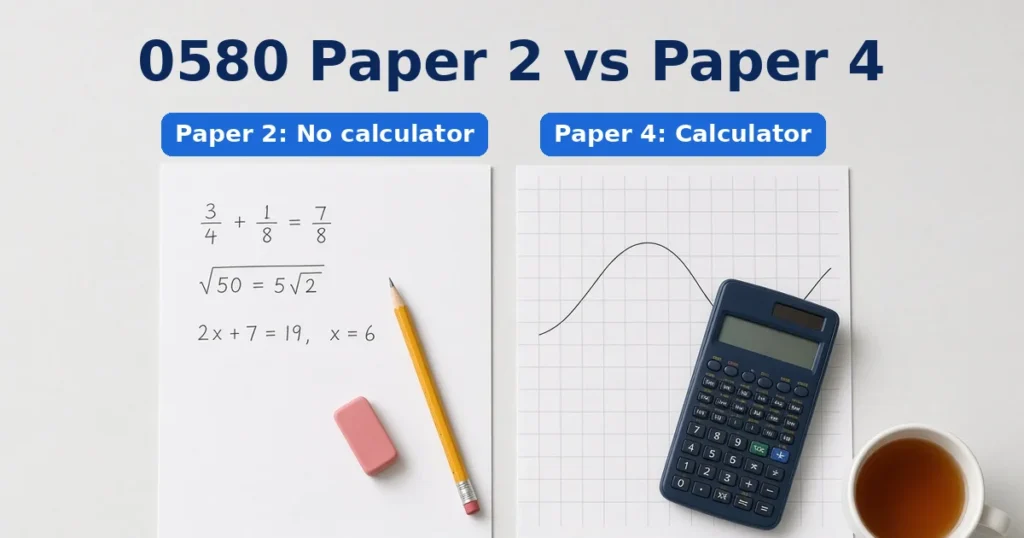
Quick answer: In the 0580 Paper 2 vs Paper 4 comparison, the big difference is the calculator. Paper 2 is non-calculator. Paper 4 needs a scientific calculator. Almost everything else is matched: both are Extended papers, both last 2 hours, both are out of 100 marks and each one counts for 50% of the IGCSE. Core students sit Paper 1 and Paper 3 instead.
If your child is on the Extended route for Cambridge IGCSE Mathematics, they will sit two papers: Paper 2 and Paper 4. Many parents still picture the older setup, where Paper 2 was the shorter paper and a calculator was allowed in every exam. That changed with the syllabus first examined in 2025.
Today the two 0580 Extended papers are built as a matching pair, with one big difference. Below is a plain comparison of the IGCSE Maths Paper 2 non-calculator paper and the IGCSE Maths Paper 4 Extended calculator paper, and what to practise for each. All paper details come from Cambridge’s 0580 syllabus for exams in 2025, 2026 and 2027.
0580 Paper 2 vs Paper 4 at a Glance
| Paper 2 | Paper 4 | |
|---|---|---|
| Tier | Extended | Extended |
| Calculator | Not allowed | Scientific calculator required |
| Time | 2 hours | 2 hours |
| Marks | 100 | 100 |
| Weighting | 50% of the IGCSE | 50% of the IGCSE |
| Question types | Structured and unstructured | Structured and unstructured |
| Formula list | Extended list on page 2 | Extended list on page 2 |
| Equipment | Geometrical instruments | Geometrical instruments and calculator |
| Grades available (Extended route) | A* to E | A* to E |
Cambridge has deliberately balanced the two papers in each tier, so they share the same duration, total marks, weighting and style. You can check the official details on the Cambridge IGCSE Mathematics 0580 page. Not sure Extended is the right tier for your child? Our guide to Core vs Extended IGCSE Maths explains how to choose.
What Paper 2 and Paper 4 Have in Common
It’s worth starting with what stays the same, because it’s more than most students expect.
- The same content. Both papers are based on the Extended subject content, so any topic can turn up on either paper. There is no separate “Paper 2 syllabus”. The one exception is the “Using a calculator” section of the syllabus, which Paper 2 doesn’t test.
- The same balance of skills. On both papers, 40–50% of the marks are for knowing and using techniques, and 50–60% are for analysing problems and communicating mathematically. So more than half of each paper is about problem solving and explaining, not just routine methods.
- The same question styles. Both mix structured questions (with parts like (a), (b), (c)(i)) and unstructured questions, where the student has to plan the method alone. One question can also combine more than one topic.
- Working matters on both. Answers are written on the question paper, and students must show all necessary working in the spaces given.
IGCSE Maths Paper 2: The Non-Calculator Paper
Paper 2 checks whether a student truly understands numbers rather than just knowing which buttons to press. Without a calculator, questions tend to use numbers that can be handled by hand, and exact answers come up naturally.
What usually feels different on Paper 2:
- Arithmetic by hand. Multiplying and dividing decimals and fractions, such as 2.4 × 0.35 = 0.84.
- Exact answers. Leaving answers in terms of π or as surds, for example √50 = 5√2. Surds were added to the Extended content in the current syllabus.
- Exact trigonometric values. Also new in the current syllabus. Students need to know values such as sin 30° = ½ and tan 45° = 1 without a calculator.
- Estimation. Rounding numbers sensibly to check whether an answer is reasonable.
IGCSE Maths non-calculator tips
- Practise written methods every week, not just before the exam. Speed comes from routine.
- Simplify before you calculate. Cancel fractions and use the index laws first, so the numbers stay small.
- Learn the key facts by heart. The syllabus expects recall of squares from 1² to 15², the cubes of 1, 2, 3, 4, 5 and 10, the matching roots, and the exact values of sin and cos for 0°, 30°, 45°, 60° and 90° (and tan for 0°, 30°, 45° and 60°).
- Leave answers exact unless the question says otherwise. If the answer is 25π, write 25π.
IGCSE Maths Paper 4: The Calculator Paper
On Paper 4, the calculator takes care of the hand arithmetic, so the paper can use realistic numbers and longer, multi-step problems. That brings its own risks: rounding too early, setting the calculator to the wrong mode, or losing track over multi-step problems.
The syllabus sets out a few clear rules for Paper 4:
- Give non-exact answers correct to 3 significant figures, or 1 decimal place for angles in degrees, unless the question asks for something different.
- Don’t round until the final answer. If a later part uses an earlier answer, use the value before it was rounded.
- For π, use the calculator’s π key or 3.142.
- Bring a scientific calculator. One with trigonometric functions is strongly recommended, and graphical or algebraic calculators are not allowed.
A quick example. Solve x² − 3x − 5 = 0, giving your answers to 2 decimal places. The quadratic formula is on the formula list, so the student writes:
x = (3 ± √(9 + 20)) ÷ 2 = (3 ± √29) ÷ 2, so x = 4.19 or x = −1.19
That substitution line is worth writing every time. If there’s a slip in the final answer, the line can still earn method marks.
How to Prepare for IGCSE Maths Paper 4
- Know your own calculator. Learn the Ans key, the memory, fractions and degree mode, and use the same calculator in practice and in the exam.
- Keep at least 4 figures in your working. Cambridge’s examiner reports for Paper 4 advise writing intermediate values to at least four significant figures and rounding only the final answer.
- Practise mixed questions. The same reports say students do well when a question clearly points to one topic, but find it harder when they have to work out which maths to use or combine several topics.
- Practise “show that” questions, where every step has to be written down in a clear order.
A quick note on 2026 papers: Cambridge has changed the layout and formatting of its question papers from March 2026 to improve accessibility, so new papers may look slightly different from older specimen papers. Cambridge says the content, demand and types of questions will not change.
The 0580 Formula Sheet: What’s Given and What Isn’t
Every 0580 paper includes a formula list on page 2 that stays the same in every exam series. The Extended list, used for both Paper 2 and Paper 4, includes the areas and volumes of common shapes, the quadratic formula, the sine rule, the cosine rule and ½ab sin C.
Not every formula is given, though. The syllabus says students must already know the speed–distance–time relationship and the simple and compound interest formulas. A good habit is to practise with the formula list in front of you, so your child learns where everything is and which formulas they still need to remember.
Timing: Two Hours, 100 Marks
Both Extended papers give 2 hours for 100 marks, which is a little over a minute per mark. A simple pacing plan that works for both papers:
- Do a first pass, answering everything you’re confident about.
- Mark any question you want to come back to, rather than getting stuck on it.
- Keep the last 10 minutes for checking accuracy, units and the form of each answer.
A lot of marks are lost through small slips rather than gaps in knowledge. Our guide to IGCSE Maths common mistakes covers the ones to watch for.
A Simple Weekly Plan for Both Papers
- Two short non-calculator sessions on arithmetic, fractions, surds and exact values.
- Two calculator sessions on longer, mixed problems.
- One timed section from a past or specimen paper, marked with the mark scheme.
- One review session going through every lost mark and writing down the fix.
It’s the quality of these sessions that counts, not just the number of hours. If your child is already studying a lot without much change in marks, read why extra IGCSE Maths hours don’t always raise the mark.
For the timed practice, these step-by-step 0580 worked solutions from the 2025 specimen papers show how each paper is answered:
- Paper 2 (non-calculator): forming and solving a quadratic, an exact trig value (cos 30°), areas of similar shapes and a tangent to a curve.
- Paper 4 (calculator): the length of AB and a perpendicular line, the surface area of a triangular prism and upper and lower bounds of a speed.
Frequently Asked Questions
Is 0580 Paper 2 non-calculator?
Yes. Under the 0580 syllabus for 2025–2027, Paper 2 (Extended) and Paper 1 (Core) are non-calculator papers. Paper 3 and Paper 4 need a scientific calculator.
Which papers do Extended students take?
Paper 2 and Paper 4. Core students take Paper 1 and Paper 3.
Is Paper 4 harder than Paper 2?
Not by design. Cambridge balances the two papers in each tier: same time, same marks, same weighting and same style. Some students find one harder than the other, depending on their strengths.
Is there a formula sheet in IGCSE Maths 0580?
Yes, on page 2 of every paper. Some formulas, such as speed–distance–time and the interest formulas, still have to be learned.
Will Paper 2 and Paper 4 change after 2027?
Not in format, based on the syllabus Cambridge has already published for 2028–2030: Paper 2 stays non-calculator, Paper 4 stays a calculator paper, and both are still 2 hours, 100 marks and 50% each.
Book a Free Trial Class
Paper 2 and Paper 4 need slightly different habits, and the quickest way to build them is with someone who can see exactly where your child hesitates. At TutorDock, every class is a live one-to-one online lesson, so the tutor can move between non-calculator practice and calculator problem solving as your child needs. Learn more on our IGCSE Mathematics (0580) tutor page or our IGCSE Maths tutor online page.
Tell us your child’s grade and which paper worries them most, and we’ll arrange a FREE 2-day trial with 2 different tutors. Your child has a real one-to-one lesson with each tutor, and then you choose the tutor who suits them best.
