
Last reviewed: October 2026
Quick answer: The most useful IGCSE Maths common mistakes to fix are the small, repeatable ones: rounding too early, not giving answers to 3 significant figures, skipping working, a calculator in the wrong angle mode, mixed-up units, ignoring the word “exact”, bounds and reverse percentages. Cambridge’s own syllabus and examiner reports for 0580 keep pointing to these same habits, and every one of them can be fixed with practice.
Every Maths teacher knows the student who “knew everything” but still dropped a grade. Usually it isn’t the hard topics. It’s small slips that quietly take a mark here and a mark there.
This guide covers 0580 common mistakes and how to fix each one, with a short example we’ve made ourselves. The list is based on Cambridge’s own 0580 syllabus and examiner reports, so these are real patterns, not guesses. Think of it as IGCSE Maths exam tips your child can start using this week.
Why Good Students Still Lose Marks in IGCSE Maths
Cambridge IGCSE Mathematics (0580) has four written papers. Core students sit Paper 1 (non-calculator) and Paper 3 (calculator). Extended students sit Paper 2 (non-calculator) and Paper 4 (calculator), as set out on the Cambridge IGCSE Mathematics 0580 page. Not sure which tier your child is on? Our guide to Core vs Extended IGCSE Maths explains the difference.
Because examiners give marks for method as well as accuracy, two students with the same final answer can end up with very different marks.
IGCSE Maths Common Mistakes in 0580 and How to Fix Them
1. Rounding in the middle of a calculation
Cambridge mentions this one again and again. The syllabus says that to earn accuracy marks, students should avoid rounding until the final answer.
Example. A right-angled triangle has shorter sides 3.7 cm and 5.2 cm. Find the hypotenuse, then the area of a square drawn on it.
- Hypotenuse = √(3.7² + 5.2²) = 6.38200… cm
- Rounded early to 6.4 and squared: 40.96, so 41.0 cm² ✗
- Kept the full value: 40.73, so 40.7 cm² ✓
The fix: keep the full number in the calculator (use the Ans key or memory), or write down at least 4 or 5 figures in working. Round only at the very end.
2. Getting 3 significant figures wrong in IGCSE Maths
On the calculator papers, the syllabus asks for non-exact answers correct to 3 significant figures, or 1 decimal place for angles in degrees, unless the question says otherwise. Cambridge’s examiner reports note that some students ignore this or work to only 2 significant figures.
Examples.
- 0.004567 to 3 s.f. is 0.00457 (leading zeros don’t count)
- 45 672 to 3 s.f. is 45 700, not 457
- An angle of 38.6598° is written 38.7°
The fix: check every final answer against the front-cover instruction. If a question asks for a different accuracy, follow the question.
3. Not showing working (and missing IGCSE Maths method marks)
Cambridge’s reports say it year after year: when working is shown, part marks can be given even if the final answer is wrong. With an answer only, one slip can cost the whole question.
Example. Decrease $3500 by 18%.
- Answer only: “2870” (if this is wrong, there’s nothing to give credit for)
- With working: 3500 × 0.82 = 2870 ✓
Write the actual multiplier (0.82 or 82/100), not just “82%”. Cambridge has pointed out that the working should show the real calculation.
The fix: one step per line, especially in algebra. Write the formula, then the numbers put into it, then the answer. If you try a question twice, cross out the attempt you don’t want marked.
4. Calculator in the wrong angle mode
Quick to fix, painful when it happens. The syllabus says angles are given and answered in degrees.
Example.
- tan 35° in degree mode = 0.700 ✓
- tan 35 in radian mode = 0.474 ✗
The fix: before Paper 3 or Paper 4 starts, check that the screen shows D or DEG. A quick test: sin 30 should give 0.5.
5. Mixing up units
Cambridge’s reports mention students missing that units in a question don’t match.
Examples.
- 1 m² = 10 000 cm², so 25 000 cm² = 2.5 m² (not 250 m²)
- 72 km/h = 72 × 1000 ÷ 3600 = 20 m/s
The fix: before calculating, write the units next to every number. Convert everything to one unit first, then give the answer in the unit the question asks for.
6. Ignoring the word “exact” or “in terms of π”
A rounded decimal won’t get full marks when the question asks for an exact answer. Cambridge’s June 2024 examiner report said answers in terms of π were likely to become more common on the non-calculator papers from 2025.
Example. Area of a circle with radius 5 cm, as an exact answer:
- 25π cm² ✓
- 78.5 cm² ✗ (not exact)
The fix: underline words like exact, in terms of π, simplest form and as a fraction. They tell you the form the answer must take.
7. Getting bounds the wrong way round
Core students find bounds of a measurement; Extended students also find bounds of calculations.
Example. A length is 8 cm, correct to the nearest centimetre.
- Lower bound = 7.5 cm, upper bound = 8.5 cm (half a unit each side)
For calculations (Extended), think about which bound makes the answer biggest or smallest. A rectangle 8 cm by 5 cm, both to the nearest cm, has an upper bound perimeter of 2 × (8.5 + 5.5) = 28 cm. For a lowest possible speed, use the smallest distance divided by the largest time.
The fix: always ask, “Do I want this answer as big as possible or as small as possible?” before choosing which bound to use.
8. Reverse percentages in IGCSE (finding the original amount)
Reverse percentages are in the Extended syllabus, and the “obvious” method is wrong.
Example. After a 20% increase, a price is $96. What was the original price?
- ✗ 96 × 0.8 = $76.80
- ✓ 96 ÷ 1.2 = $80
Check: 80 × 1.2 = 96. ✓
The fix: the new amount is a percentage of the original, so divide by the multiplier. Then check by working forwards.
9. A minus sign in front of a bracket
Cambridge’s examiner report reminds students that a minus sign in front of a bracket changes the sign of every term inside.
Example. Simplify 5 − (x − 3).
- ✗ 5 − x − 3 = 2 − x
- ✓ 5 − x + 3 = 8 − x
The fix: before expanding, draw a small arrow from the minus sign to each term in the bracket.
10. Giving an answer that doesn’t make sense
Example. 230 people need buses that carry 50 each. 230 ÷ 50 = 4.6, so the answer is 5 buses, not 4.6 and not 4.
The fix: after each answer, read the question again and ask: “Is this sensible? Is it in the form they asked for?”
IGCSE Maths Non-Calculator Tips
Papers 1 and 2 don’t allow a calculator, so these habits matter:
- Practise written methods for multiplying and dividing decimals until they feel automatic.
- Simplify fractions before multiplying. Cancelling first keeps the numbers small.
- Estimate first. If the question says to round to 1 significant figure, do that before calculating, not after.
- Keep π as π unless the question tells you otherwise.
How to Practise So These Mistakes Stop
In my years of teaching, I’ve noticed that most of these mistakes come from one thing: not enough regular practice. Students often skip daily practice and don’t spend enough time on past papers. The more past paper questions a student solves, the faster these common mistakes disappear, because the right habits start to feel automatic.
My best tip for students: solve past paper questions on your own first, then open the mark scheme and check your answers yourself, line by line. When you find your own slips, you remember them. In my experience, this self-checking habit gets rid of most of these mistakes, and it makes a huge difference.
Spotting these patterns is only half the job. This simple practice routine helps better habits stick:
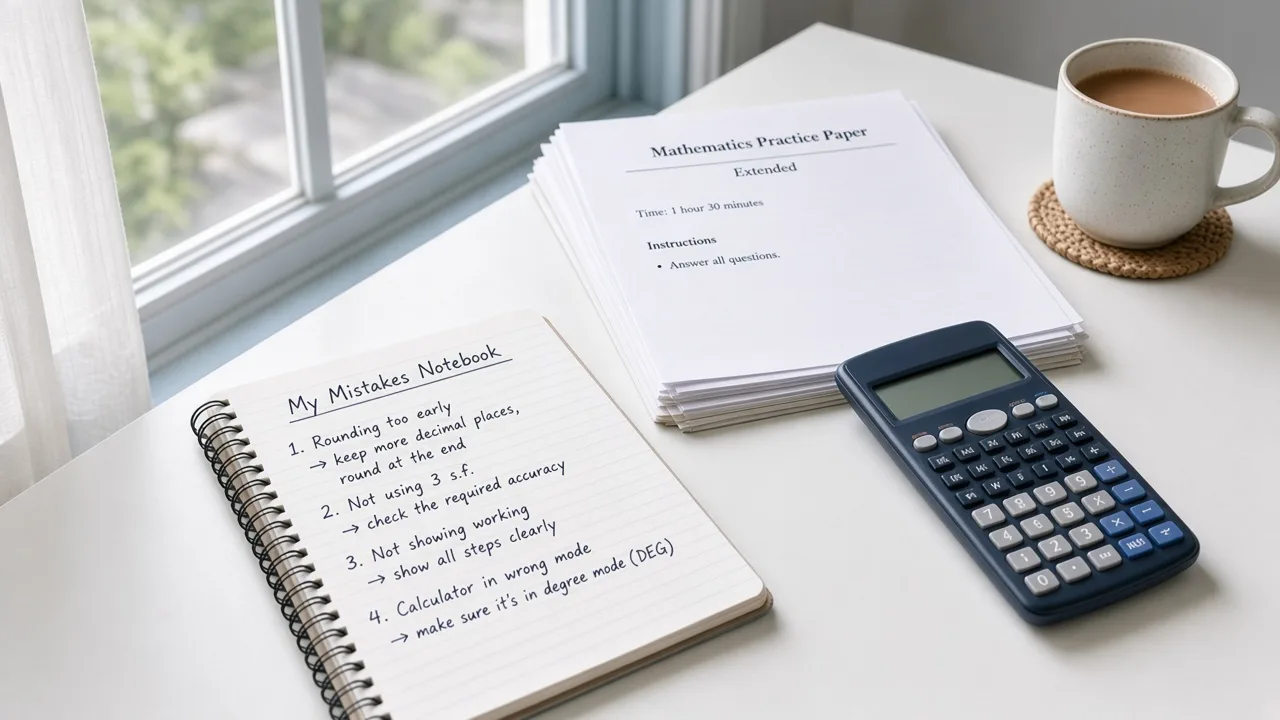
- Keep a “mistakes notebook”. Every time a mark is lost in practice, write down the slip and the fix.
- Mark with the mark scheme, not just the answer. See where method marks were given.
- Do short, timed sets of 5 or 6 questions on one topic, rather than only full papers.
- Read the examiner report for papers you practise. It shows where marks were lost.
If your child’s IGCSE results are coming up, our parent’s guide to Cambridge IGCSE results January 2027 explains the dates and what to do next.
Frequently Asked Questions
What are the most useful IGCSE Maths mistakes to fix first?
Rounding too early, not showing working and wrong accuracy. They come up in many different topics, so fixing them can help across the whole paper.
Do you get marks for working in IGCSE Maths if the answer is wrong?
Often, yes. Many questions give method marks for correct working, even when the final answer is wrong. Without working, there’s nothing to give credit for.
How many significant figures should IGCSE Maths answers have?
On the calculator papers, Cambridge asks for non-exact answers to 3 significant figures, or 1 decimal place for angles in degrees, unless the question says otherwise.
What value of π should my child use?
The 0580 syllabus says to use the π key on the calculator or 3.142.
Book a Free Trial Class
Most of these mistakes are habits, and habits change fastest when someone watches how your child works and corrects the slip the moment it happens. That’s what a live one-to-one lesson allows. At TutorDock, your child works with one tutor on their own papers, at their own pace. See how we support students on our IGCSE Mathematics (0580) tutor page, or explore our IGCSE Maths tutor online page.
Tell us your child’s grade, syllabus and the topics they find hard, and we’ll arrange a FREE 2-day trial with 2 different tutors. Your child has a real one-to-one lesson with each tutor, and then you choose the tutor who suits them best.
