
Last reviewed: November 2026
Quick answer: Cambridge A Level Maths 9709 splits Pure vs Mechanics vs Statistics across six papers. Three are Pure (Papers 1, 2 and 3), one is Mechanics (Paper 4) and two are Probability & Statistics (Papers 5 and 6). Every student takes Pure Mathematics 1. A full A Level is always Papers 1, 3 and 5, plus either Mechanics (Paper 4) or Probability & Statistics 2 (Paper 6). Papers 4 and 6 can’t be combined.
“Mechanics or Stats?” It’s one of the first questions families ask when a child starts A Level Maths. Often it’s a parent, holding a school options form and wondering why maths suddenly has a menu.
Pure vs Mechanics vs Statistics isn’t a choice between easy and hard. It’s a choice about what kind of maths your child will spend two years doing. This guide is written mainly for parents in Saudi Arabia, the UAE and Qatar whose children follow Cambridge A Levels. We’ll go through the 9709 papers one by one, using Cambridge’s syllabus for exams in 2026 and 2027, and then look at how to choose.
Pure vs Mechanics vs Statistics: The Six 9709 Papers
| Paper | Name | Time | Marks | Weight |
|---|---|---|---|---|
| 1 | Pure Mathematics 1 | 1 h 50 min | 75 | 60% of AS / 30% of A Level |
| 2 | Pure Mathematics 2 | 1 h 15 min | 50 | 40% of AS (AS only) |
| 3 | Pure Mathematics 3 | 1 h 50 min | 75 | 30% of A Level (A Level only) |
| 4 | Mechanics | 1 h 15 min | 50 | 40% of AS / 20% of A Level |
| 5 | Probability & Statistics 1 | 1 h 15 min | 50 | 40% of AS / 20% of A Level |
| 6 | Probability & Statistics 2 | 1 h 15 min | 50 | 20% of A Level (A Level only) |
Students need a calculator with standard scientific functions in every 9709 paper. Graphical calculators and calculators that do algebra, differentiation or integration are not allowed. Students also get a list of formulae and statistical tables, called MF19, in the exam. Exams run in the June and November series. Past papers for each component are collected on our A Level Maths 9709 past papers page.
Pure: The Part Nobody Skips
Pure Mathematics 1 is the foundation of the whole course. Cambridge says so directly, and the Mechanics and Statistics papers assume its content: quadratics, functions, coordinate geometry, circular measure, trigonometry, series, differentiation and integration.
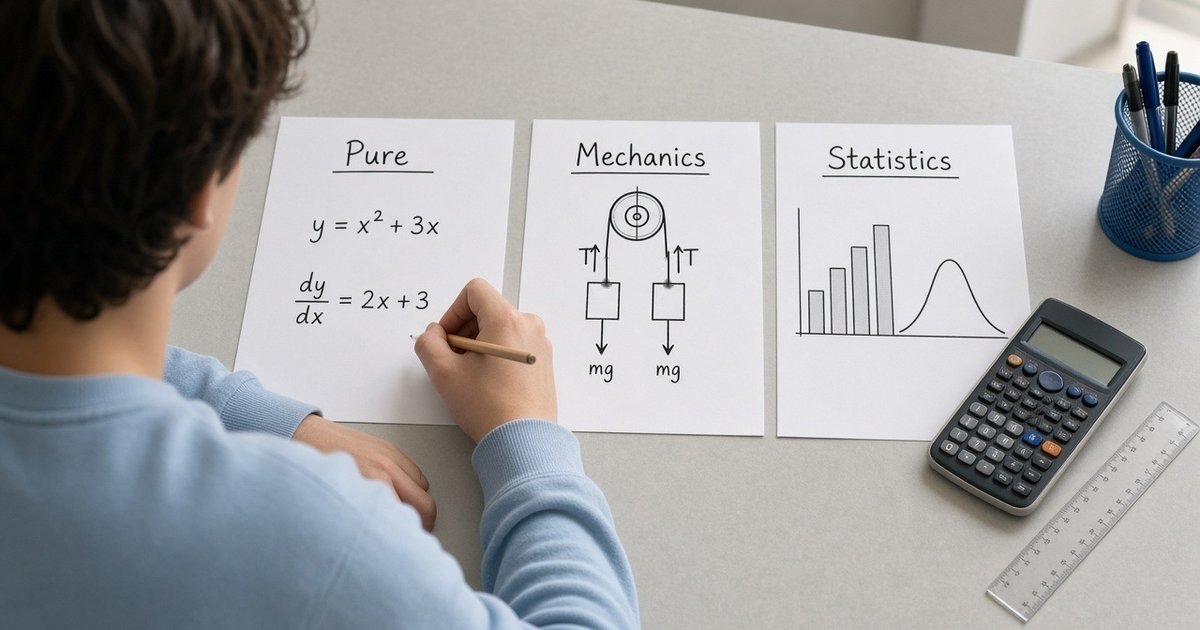
What does Pure feel like day to day? Lots of algebra, and long chains of reasoning where one slip in line two can ruin line nine. For example, differentiating y = 2x³ − 5x to get dy/dx = 6x² − 5 is the kind of routine step your child will see in almost every Pure lesson.
Then there’s a fork. Paper 2 (Pure 2) is for AS Level only. Paper 3 (Pure 3) is for the full A Level, and it goes further, adding vectors, differential equations and complex numbers. Cambridge says Paper 2’s content is largely a subset of Paper 3, and a student can’t sit both in the same series.
Cambridge also assumes students already know IGCSE Mathematics 0580 (Extended) or O Level Mathematics 4024 content before they start. Our guides to O Level Maths vs IGCSE Maths and the IGCSE Maths formula sheet can help you judge that foundation.
Mechanics: Maths That Moves
Paper 4 is about forces and motion: forces and equilibrium, kinematics in a straight line, momentum, Newton’s laws of motion, and energy, work and power.
A typical idea: a car starts from rest and accelerates at 2 m/s² for 5 seconds. Its speed is then 10 m/s, and it has travelled 25 m. The syllabus then builds on ideas like this with friction, inclined planes and connected particles, such as two particles joined by a string over a pulley. A clear force diagram helps with almost every one of these questions.
The ideas overlap with A Level Physics, which also covers motion, forces and energy. If your child takes both subjects, our A Level Physics 9702 guide shows what the Physics course covers.
Statistics: Maths About Uncertainty
Paper 5, Probability & Statistics 1, covers representing data, permutations and combinations, probability, discrete random variables and the normal distribution. A small taste: how many different ways can you arrange the letters of LEVEL? Five letters, with two Ls and two Es, so 5! ÷ (2! × 2!) = 30.
Paper 6, Probability & Statistics 2, builds directly on Paper 5. It covers the Poisson distribution, linear combinations of random variables, continuous random variables, sampling and estimation, and hypothesis tests. It is offered only as part of the full A Level.
Statistics also asks for words, not just numbers. In Paper 6 hypothesis tests, for example, the syllabus expects conclusions to be interpreted in the context of the question, so careful reading and clear sentences matter as much as the calculation.
9709 AS Level Routes
Cambridge allows three AS combinations. Each has Pure 1 plus one other paper, taken in the same series:
- Paper 1 + Paper 2 (Pure only)
- Paper 1 + Paper 4 (Pure and Mechanics)
- Paper 1 + Paper 5 (Pure and Statistics)
One trap here: the Pure-only AS (Papers 1 and 2) cannot be carried forward to a full A Level. A student who takes it and later wants the A Level has to follow a different route. So if there’s any chance your child will continue, it’s worth discussing this with the school before choosing the Pure-only AS. AS Level students are graded a to e, and full A Level students A* to E.
A Level Maths: Mechanics or Statistics?
For the full A Level, everyone sits Paper 1, Paper 3 and Paper 5. The real choice is the fourth paper:
| Route | Papers | Mix |
|---|---|---|
| Mechanics route | 1, 3, 4, 5 | Pure + Mechanics + Statistics |
| Statistics route | 1, 3, 5, 6 | Pure + Statistics only |
Papers 4 and 6 can’t be combined, because Paper 6 depends on Paper 5 content. Students can take all four papers in one series (the linear route) or take the AS in the first year and the other two papers in a later series (the staged route), carrying the AS result forward under Cambridge’s rules and time limits.
Notice something? Probability & Statistics 1 is in both A Level routes. So the real question isn’t “Mechanics or Statistics”. It’s “Mechanics or more Statistics”.
Which A Level Maths Route to Choose?
Every student’s strengths are different, but four practical points usually make the decision clear.
- Other subjects and plans: Physics or engineering plans lean towards Mechanics, while biology, psychology, economics or business connect more naturally with Statistics.
- Further Maths plans: Cambridge recommends certain 9709 combinations to support progression to Further Mathematics 9231, so it is worth checking ahead with the school (and see our Further Maths 9231 page).
- What the school offers: Some schools offer only one fourth-paper route, which can make the decision for you.
- What your child enjoys: Some students love a clean force diagram and a calculation that balances, while others prefer interpreting real-world data and judging what’s likely. Neither is “smarter”.
Strong Pure skills matter in both routes, because Pure 1 and Pure 3 together make up 60% of the A Level.
The jump from IGCSE into Pure can feel big. IGCSE Additional Maths covers some of the same ground, such as logarithms, radians and calculus, which can make the start of A Level smoother. Our IGCSE Additional Maths (0606) tutor page explains more.
Frequently Asked Questions
How many papers are in A Level Maths 9709?
There are six papers, but no student takes all of them. AS Level is two papers, and the full A Level is four.
Is Paper 5 compulsory for A Level?
Yes. Both full A Level routes include Probability & Statistics 1.
Can my child take Mechanics and Statistics 2 together?
No. Paper 4 and Paper 6 can’t be combined in the A Level.
Does the Pure-only AS count towards the A Level?
No. The Papers 1 and 2 route is AS only and can’t be carried forward.
Is a calculator allowed in every 9709 paper?
Yes, a scientific one. Working must still be shown, because Cambridge gives no marks for unsupported answers from a calculator. Full details are in the 9709 syllabus for 2026 and 2027 and on Cambridge’s AS & A Level Mathematics 9709 page.
Book a Free Trial Class
Choosing between Mechanics and Statistics is easier after a couple of real lessons than after an hour of reading. In live one-to-one online classes, a TutorDock tutor can try a little of each with your child and see what clicks. Have a look at our A Level Maths (9709) tutor page, then tell us the route your child is on, or still deciding about.
We’ll arrange a FREE 2-day trial with 2 different tutors. Your child has a real one-to-one lesson with each tutor, and then you choose the tutor who suits them best.
