
Last reviewed: November 2026
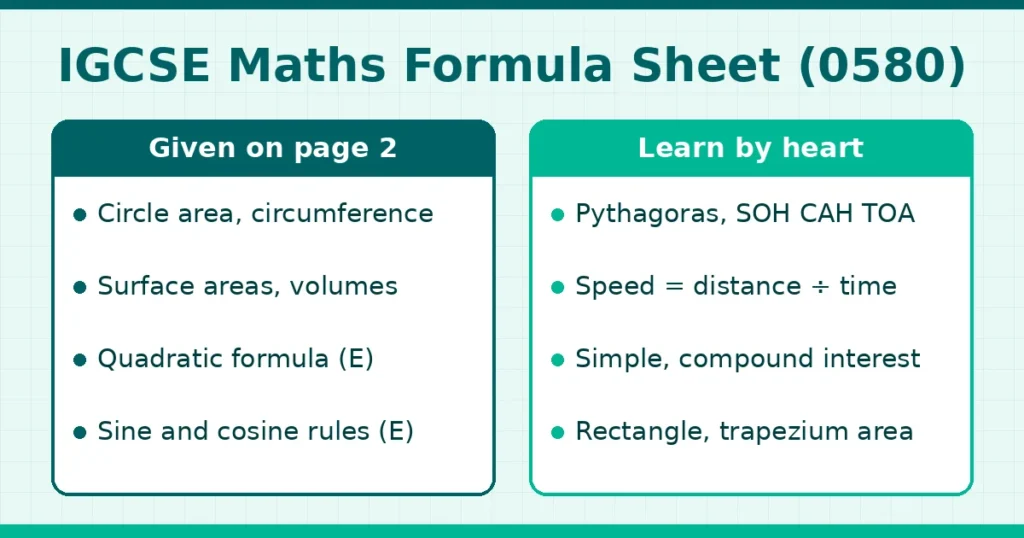
Quick answer: Yes, there is an IGCSE Maths formula sheet. Every Cambridge 0580 paper has a list of formulas on page 2. The Core list covers areas, circumference, surface areas and volumes. The Extended list has the same formulas plus the quadratic formula, the sine rule, the cosine rule and Area = ½ab sin C. Many formulas are not given, including Pythagoras’ theorem, the trigonometry ratios, speed = distance ÷ time, simple and compound interest, and the areas of a rectangle, parallelogram and trapezium.
“Do we get a formula sheet?” is one of the first questions students ask before a maths exam. For Cambridge IGCSE Mathematics 0580, the answer is yes. The IGCSE Maths formula sheet is helpful but brief, and Cambridge is clear that it does not include every formula your child needs.
This guide sets out exactly what is on the 0580 formula sheet for Core and Extended, what is missing, and a simple way to learn the rest. It is written mainly for parents in Saudi Arabia, the UAE and Qatar whose children sit Cambridge 0580, but the list is the same wherever the exam is taken. Everything here comes from Cambridge’s 0580 syllabus for exams in 2025, 2026 and 2027.
What’s on the IGCSE Maths Formula Sheet?
With the syllabus first examined in 2025, Cambridge introduced a formula sheet for all 0580 papers. It is printed on page 2 of each paper. There is one list for Core (Papers 1 and 3) and one for Extended (Papers 2 and 4), and Cambridge says the formula sheet will be the same for each series. This lets your child get familiar with it well before exam day, so nothing on it comes as a surprise.
The syllabus also gives a clear warning: “not all required formulas are given”. In the syllabus content, the “Notes and examples” column shows when a formula is given and when knowledge of a formula is required.
IGCSE Maths Formula List: Core and Extended
| Formula on the sheet | Core list | Extended list |
|---|---|---|
| Area of a triangle, A = ½bh | ✓ | ✓ |
| Area of a circle, A = πr² | ✓ | ✓ |
| Circumference of a circle, C = 2πr | ✓ | ✓ |
| Curved surface area of a cylinder, A = 2πrh | ✓ | ✓ |
| Curved surface area of a cone, A = πrl (l = sloping edge) | ✓ | ✓ |
| Surface area of a sphere, A = 4πr² | ✓ | ✓ |
| Volume of a prism, V = Al (A = cross-sectional area) | ✓ | ✓ |
| Volume of a pyramid, V = ⅓Ah | ✓ | ✓ |
| Volume of a cylinder, V = πr²h | ✓ | ✓ |
| Volume of a cone, V = ⅓πr²h | ✓ | ✓ |
| Volume of a sphere, V = ⁴⁄₃πr³ | ✓ | ✓ |
| Quadratic formula, x = (−b ± √(b² − 4ac)) ÷ 2a | ✓ | |
| Sine rule, a/sin A = b/sin B = c/sin C | ✓ | |
| Cosine rule, a² = b² + c² − 2bc cos A | ✓ | |
| Area of a triangle, ½ab sin C | ✓ |
IGCSE Maths Extended formulas
The four extra Extended formulas are for algebra and trigonometry: solving quadratic equations that don’t factorise, and working with triangles that are not right-angled. They appear on both Extended papers, including the non-calculator Paper 2. To see how the two Extended papers differ, read our guide to 0580 Paper 2 vs Paper 4.
Not sure which tier your child is entered for? Our guide to Core vs Extended IGCSE Maths explains the difference.
Formulas Not Given in IGCSE Maths
This is where many students get caught out. Based on the 0580 syllabus notes and on what is missing from the two lists, these formulas are not on the sheet:
- Area of a rectangle, parallelogram and trapezium. The syllabus says that, except for the area of a triangle, area formulas are not given.
- Speed, distance and time. The syllabus says knowledge of the speed/distance/time formula is required.
- Simple and compound interest. The syllabus says these formulas are not given (Core and Extended).
- Pythagoras’ theorem. It is not on either list.
- Sine, cosine and tangent ratios for right-angled triangles. These are not on either list.
- Volume and surface area of a cuboid. Not listed, though the volume follows from the prism formula.
- Arc length and sector area. The syllabus treats these as fractions of the circumference and area of a circle, so students need the method. (On Core, the sector angle is a factor of 360.)
- Exact trigonometric values (Extended only). Students must know sin and cos of 0°, 30°, 45°, 60° and 90°, and tan of 0°, 30°, 45° and 60°.
Some topics work the other way. For rates like pressure, density and population density, the syllabus says the required formulas will be given in the question. And for conditional probability (Extended), the syllabus says knowledge of the notation P(A|B) and of formulas for conditional probability is not required. Students work from Venn diagrams, tree diagrams and tables instead.
IGCSE Maths Formulas to Memorise
Here is a practical memory list built from the gaps above:
- Area: rectangle = length × width; parallelogram = base × perpendicular height; trapezium = ½(a + b)h
- Pythagoras: a² + b² = c², where c is the longest side
- Trig ratios: sin = opposite ÷ hypotenuse, cos = adjacent ÷ hypotenuse, tan = opposite ÷ adjacent
- Speed: speed = distance ÷ time
- Simple interest: interest = principal × rate × time ÷ 100
- Compound interest: final amount = principal × (1 + r/100)ⁿ
- Arc length: (angle ÷ 360) × 2πr. Sector area: (angle ÷ 360) × πr²
- Extended only: the exact values of sin, cos and tan listed above
Three quick examples
- Trapezium: parallel sides 6 cm and 10 cm, height 4 cm. Area = ½ × (6 + 10) × 4 = 32 cm². None of this is on the sheet.
- Compound interest: 2000 invested at 3% per year compound interest for 4 years. 2000 × 1.03⁴ = 2251.0176…, so the final amount is 2251.02 (to 2 decimal places).
- Arc length: a sector with angle 60° and radius 9 cm. (60 ÷ 360) × 2 × π × 9 = 3π cm, or 9.42 cm to 3 significant figures.
How to Use the 0580 Formula Sheet Well
A formula on the page only helps if your child knows how to use it. Cambridge’s own guidance for teachers says learners need to practise selecting the correct formula from the formula sheet and knowing when to use it.
- Know what every letter means. In the cone formula A = πrl, l is the sloping edge, not the vertical height. Mixing them up is a common slip.
- Watch for “curved” surface area. The cylinder and cone formulas give only the curved part. For a closed cylinder, add the two circular ends: total surface area = 2πr² + 2πrh.
- Write the formula in your working, then substitute the numbers. It shows the method, which can earn marks even if the final answer goes wrong.
- Practise with the sheet beside you. Use the same list when doing past papers, so finding a formula takes seconds, not minutes.
Plenty of marks are lost on small details like these. Our guide to IGCSE Maths common mistakes covers more of them, with fixes.
To see formulas used in real exam questions, work through these 0580 specimen paper solutions: surface area of a triangular prism, bounds of a speed (speed = distance ÷ time is not given), an exact trig value (exact values are not given) and solving a quadratic.
A Simple Way to Learn the Formulas That Aren’t Given
- Make one revision card with only the formulas on the memory list above.
- Write them from memory at the start of each study session, then check against the card.
- Use each one in a question the same day, so it is linked to a real problem, not just a line of letters.
- Test again a week later. Anything forgotten goes back on the card.
Ten minutes a few times a week is usually enough. The goal is for your child to spend exam time solving the problem, not trying to recall a formula.
Frequently Asked Questions
Is there a formula sheet in IGCSE Maths?
Yes. Every 0580 paper has a list of formulas on page 2, with one list for Core and one for Extended.
Is the quadratic formula given in IGCSE Maths?
Yes, on the Extended list (Papers 2 and 4). It is not on the Core list.
Is Pythagoras’ theorem on the formula sheet?
No. It is not on either list, so students need to know it.
Is the compound interest formula given?
No. The syllabus says the simple and compound interest formulas are not given.
Does the formula sheet change each year?
Cambridge says the formula sheet will be the same for each series. Check the 0580 syllabus for 2025–2027 and the Cambridge IGCSE Mathematics 0580 page for the latest details.
Book a Free Trial Class
Knowing which formulas to learn is half the job. Using them confidently under time pressure is the other half. In live one-to-one online lessons, a TutorDock tutor checks which formulas your child really knows and builds the rest into regular practice, at times that fit around the school day. Find out more on our IGCSE Mathematics (0580) tutor page.
Tell us your child’s grade and tier, and we’ll arrange a FREE 2-day trial with 2 different tutors. Your child has a real one-to-one lesson with each tutor, and then you choose the tutor who suits them best.
