
Last reviewed: November 2026
Quick answer: The best way to study for IGCSE at home is to work from the official syllabus, not from memory of what was taught. Turn the syllabus into a checklist, plan a short weekly routine, revise actively by answering questions rather than re-reading notes, practise past papers and mark them with the mark scheme, and fix the same mistakes until they stop happening. A parent’s main job is to protect the routine, not to teach the subject.
Many parents in Saudi Arabia, the UAE, Qatar and the UK ask us how to study for IGCSE at home when school lessons finish for the day. The good news is that a clear plan matters more than long hours. This guide gives a simple, practical plan your child can follow, with a few ways you can help.
How to Study for IGCSE at Home: Start With the Syllabus
Every Cambridge IGCSE subject has an official syllabus. Cambridge says its syllabuses and specimen materials “represent the final authority on the content and structure” of its assessments. So the syllabus is the most reliable list of what can be tested.
- Download the syllabus for each subject from Cambridge’s website. Check it is the right syllabus code and the right exam years.
- Check Core or Extended. In the Cambridge IGCSE sciences, Extended content is the Core plus extra “Supplement” content. In Maths 0580, Extended content includes all of the Core. Make sure your child revises the right content for their tier. Our guide to Core vs Extended IGCSE Maths explains the difference.
- Turn it into a checklist. For each topic, your child marks it green (confident), amber (unsure) or red (don’t know yet).
- Start with the reds and ambers. That is where the marks are.
An IGCSE Study Timetable That Works
There’s no single correct number of hours. Cambridge designs its IGCSE syllabuses to need about 130 guided learning hours per subject, but says this is for guidance only and the time a learner needs can vary. Home study is extra to that, and the quality of the time counts more than the amount. Our article on why extra IGCSE Maths hours don’t always raise the mark explains why.
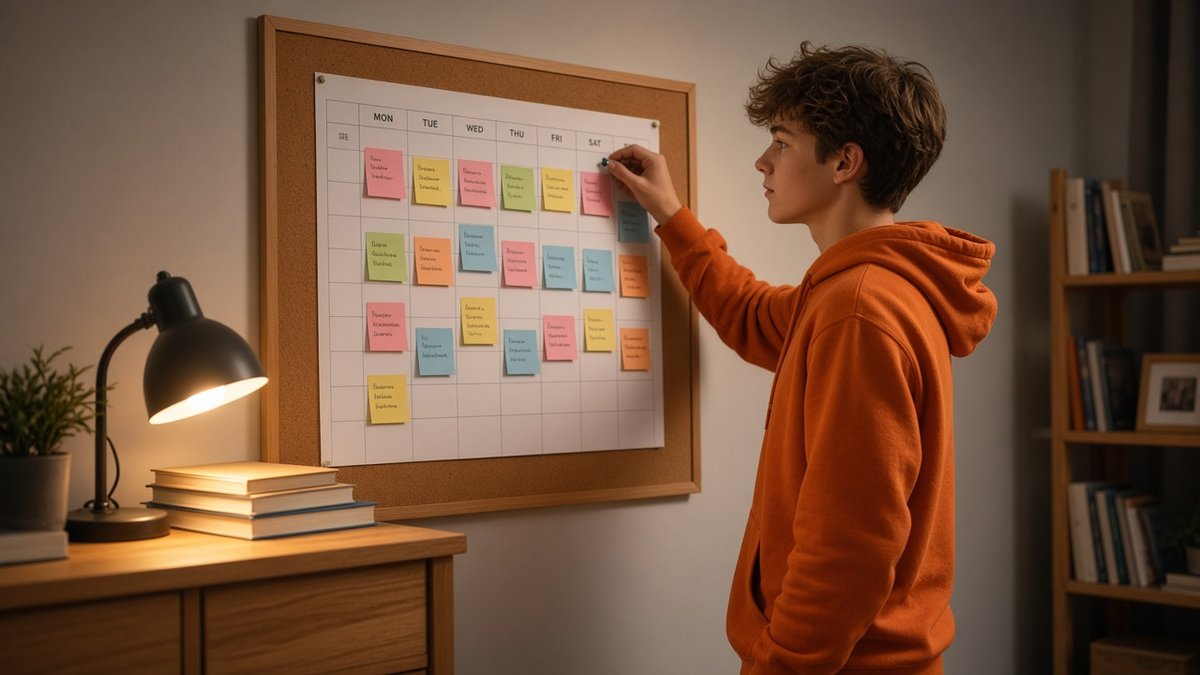
A simple weekly routine:
| Step | What your child does |
|---|---|
| Plan | At the start of the week, choose a few topics from the red and amber list |
| Short sessions | Study one topic at a time, with short breaks and the phone in another room |
| Mix subjects | Rotate subjects across the week, so each one comes up more than once |
| Review | Go back to last week’s topics briefly before starting new ones |
| Test | End the week with a set of exam questions on those topics, then mark them |
Fit the routine around school, family time, Friday prayers and, during Ramadan, the changed daily timings. A plan your child can keep is better than an ambitious plan they drop after a week.
Active Revision for IGCSE: Do, Don’t Just Read
Re-reading notes and highlighting can feel productive, but they don’t show whether your child can answer a question. Active methods do:
- Test from memory. Close the book and write down everything about a topic, then check what was missed.
- Flashcards for definitions, formulas and key facts, with the answer on the back.
- Explain it out loud. If your child can explain a topic to you simply, they understand it.
- Do questions, then mark them. This is the closest thing to the real exam.
- Keep a mistakes list. Write down each mistake and the correct method, and review the list each week.
How to Use IGCSE Past Papers
Past papers are the most useful home study tool once the content has been learned. Our past papers hub has links by subject, such as IGCSE Maths 0580 past papers.
- Topic questions first. Early on, practise questions on one topic at a time.
- Full papers later. Closer to the exam, do whole papers in the real time, in a quiet room.
- Mark with the mark scheme. Read what each mark is given for, not just the final answer.
- Read the command word. “State”, “describe” and “explain” ask for different things. Cambridge lists the command words and their meanings in each syllabus. See our guide to IGCSE science command words.
- Show working. Our guides to IGCSE Maths common mistakes and earning method marks show how marks are lost and kept.
- Don’t skip the practical paper. In the sciences, practical skills are assessed too. Our guide to IGCSE Physics 0625 Paper 6 shows how to prepare for the Alternative to Practical paper.
To get a rough idea of a grade, you can compare a practice mark with Cambridge’s published grade threshold tables for that same paper and series. Thresholds change each series, so treat it as a guide only. Our guide to IGCSE grade boundaries explains how to read those tables.
How Parents Can Help With IGCSE Revision
You don’t need to know the subject to help. The most useful things are:
- A regular time and a quiet place to study, without a phone or TV nearby.
- Asking, not checking. “What did you get wrong today, and why?” teaches more than “Did you finish?”
- Noticing patterns. If the same topic stays red for weeks, it’s time to get help with it.
- Looking after sleep, food and breaks, especially close to exams.
- Keeping calm. Steady effort over months works better than panic in the last weeks.
When to Get Extra Help
Home study works best when your child knows what to do and is making steady progress. It may be time for extra help if:
- the same topics stay red or amber for a long time
- past paper marks aren’t improving
- your child doesn’t know how to start a question
- revision often ends in stress or arguments at home
One-to-one help lets a tutor focus on exactly the topics your child finds hard. You can read how our online tutoring works, including scheduling and progress notes for parents.
Frequently Asked Questions
How many hours a day should my child study for IGCSE at home?
There’s no fixed number. A short, regular routine of focused study, with breaks, usually works better than long sessions that are hard to keep up. Adjust it to your child’s school load and exam dates.
When should my child start revising for IGCSE?
Starting early makes it easier. A steady routine through the course, with more past paper practice closer to the exams, avoids a last-minute rush.
Is re-reading notes a good way to revise?
On its own, not really. Re-reading can feel familiar without showing whether your child can answer a question. Testing from memory and doing exam questions show what they really know.
Should my child use past papers from older syllabuses?
They can be useful, but check the current syllabus first. Topics and paper structures can change between syllabus versions, so skip any question on content that is no longer in the syllabus.
Can my child study for IGCSE at home without a tutor?
Yes, many students do, with a clear plan and good past paper practice. A tutor helps most when your child is stuck on the same topics, or isn’t sure how to improve their marks.
Book a Free Trial Class
If your child would like support alongside home study, TutorDock offers live one-to-one online lessons on a laptop, tablet or phone. Lessons are available on weekdays and weekends, and timings can be adjusted for Ramadan and Friday prayers. See our IGCSE and O Level Science tutoring and IGCSE Maths tutoring pages.
Tell us your child’s subject and exam series, and we’ll arrange a FREE 2-day trial with 2 different tutors. Your child has a real one-to-one lesson with each tutor, and then you choose the tutor who suits them best.
