
Last reviewed: October 2026
Quick answer: IGCSE Maths method marks are given for a correct method, even when the final answer is wrong. To earn them, write the method down: the formula, the numbers you put into it, and each step on its own line. If a question asks you to show your working, a correct answer on its own will not get full marks.
Every maths teacher has seen it: a student who clearly knows the topic, makes a slip on one number, and walks away with zero marks because the page shows only a final answer. That’s the frustrating part. The good part is that IGCSE Maths method marks are some of the easiest marks to protect, once your child knows what examiners are looking for.
This guide explains showing working in IGCSE Maths in plain terms: how the 0580 marking works, what Cambridge’s examiner reports keep saying, and the habits that turn messy working into marks. Everything here is based on Cambridge’s 0580 syllabus, specimen mark schemes and examiner report, with our own examples.
How IGCSE Maths Method Marks Work: The 0580 Mark Scheme Explained
Cambridge mark schemes for 0580 use three standard types of mark:
- M (method) marks are for a valid method applied to the problem.
- A (accuracy) marks are for a correct answer or a correct intermediate step. An A mark can only be given if the related method mark is earned or implied.
- B marks are for a correct result or statement on its own, independent of method.
You can see this in Cambridge’s own 2025 specimen Paper 4 mark scheme. One 2-mark question asks for a height, and the scheme gives M1 for writing the volume equation 10 × 12 × h = 600. A student who writes that line but makes an arithmetic slip on the final step still earns 1 mark out of 2.
A few more rules are worth knowing. Marks are awarded positively, so examiners don’t deduct marks for errors or omissions. Once a mark is earned, wrong working written after a correct answer is normally ignored. And unless the question names a method, any correct method can earn full marks. Your child doesn’t need to use “the teacher’s method”, but they do need to show it.
IGCSE Maths follow through marks
Mark schemes also use “FT”, which means follow through after an error. If part (a) is wrong and part (b) uses that wrong answer correctly, part (b) can still earn credit where the scheme allows it. That only works if the examiner can see what your child did with their part (a) answer.
Why Showing Working Matters So Much
The 0580 syllabus is direct about this. Candidates “must show all necessary working”, and if a question asks them to show their working, they “cannot gain full marks without clearly communicating their method, even if their final answer is correct”.
Cambridge’s June 2024 examiner report repeats the same message across papers. Showing working allows part marks when the correct answer is not seen, and only working that can be seen and followed can earn method marks.
Here’s a simple example. A $240 bag goes up by 15%, then the new price drops by 10%. Find the final cost.
Weak answer: $248.60 (a small slip, and no marks).
Strong answer:
240 × 1.15 = 276
276 × 0.9 = 248.4
Final cost = $248.40
If the student slips on the second line, the examiner can still see the correct multiplier 1.15 and the method. A bare wrong answer gives the examiner nothing to mark.
How to Show Working in Maths Exams: 7 Habits
1. Write the formula, then the substitution
Start with the formula, then show the numbers going in. For a cone with radius 4 cm and height 9 cm:
V = ⅓πr²h = ⅓ × π × 4² × 9 = 48π = 151 cm³ (to 3 s.f.)
Even if the final button press goes wrong, the substitution line shows the method.
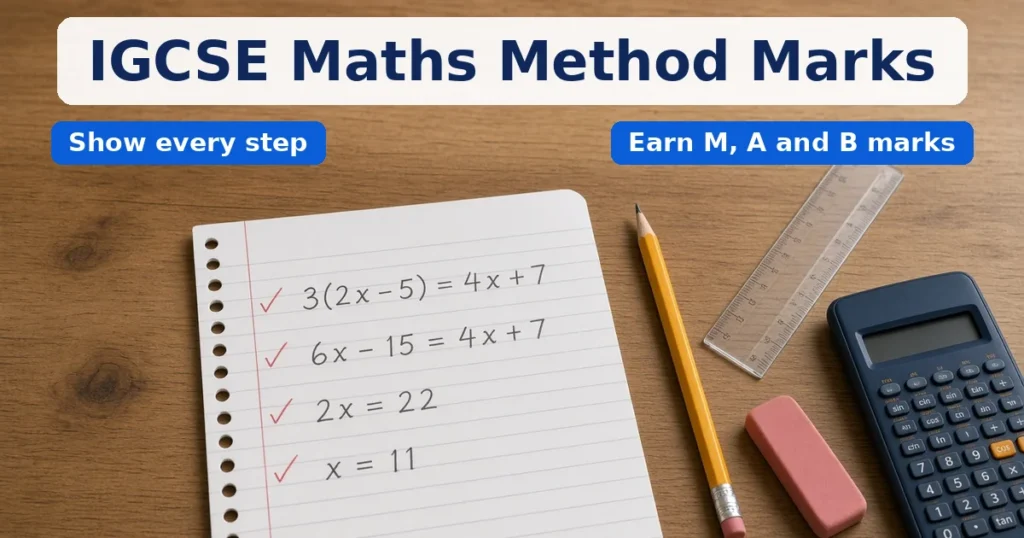
2. One step per line in algebra
The June 2024 report notes that students who did two steps of algebraic rearranging in one line could miss the chance of method marks. Keep it steady:
3(2x − 5) = 4x + 7
6x − 15 = 4x + 7
2x = 22
x = 11
3. Write percentages as decimals or fractions in working
One 2024 report says students needed to write 0.18 or 18/100 in their calculation, not just “18%”. The same goes for multipliers: write 0.82 or 82/100, not just “82%”.
4. Keep extra figures, round at the end
Always keep intermediate values to at least four significant figures and round only your final answer. Rounding too early is one of the most common ways to lose marks. For more on rounding slips, see our guide to IGCSE Maths common mistakes.
5. Make it clear which attempt counts
If a student shows multiple attempts and none clearly lead to the answer line, examiners mark all attempts and award the lowest mark. So when you replace an attempt, draw a single line through the old one, so it can still be read. But don’t cross out working you haven’t replaced, because a correct method can be overlooked.
6. Work down the page in order
The examiner report asks students to work down the page and from left to right. Working scattered around the answer space is hard to follow, and working that can’t be followed can’t earn marks.
7. Make every digit clear
Write numbers carefully, especially 4s and 9s, and 1s and 7s. The 2024 report also says some students changed answers by writing one digit over another, which made the answer hard to read. If you need to change it, cross it out and write it again.
IGCSE Maths Show That Questions
“Show that” questions give you the answer, so the marks are all for the working. The 2024 report says students need to show the individual steps in a clear order leading to the result. The syllabus adds an important rule: if you’re asked to show a value to a certain accuracy, write your working and your answer to at least one more degree of accuracy than the one asked for.
Example: Show that the area of a triangle with sides 7 cm and 9 cm and an included angle of 40° is 20.2 cm², correct to 3 significant figures.
Area = ½ab sin C
= ½ × 7 × 9 × sin 40°
= 20.247… cm²
= 20.2 cm² (3 s.f.)
Writing only “½ × 7 × 9 × sin 40 = 20.2” skips the step that proves the claim. The line 20.247… is what shows the examiner the value really does round to 20.2.
Does Working Matter on the Calculator Paper Too?
Yes. Cambridge’s Paper 4 reports say students should show full working so method marks can be considered when final answers are wrong. A calculator does the arithmetic, but it doesn’t show the examiner your method. On the non-calculator paper, the working is often the whole point of the question. Our comparison of 0580 Paper 2 vs Paper 4 explains how the two Extended papers differ.
The same habits apply whether your child sits Core or Extended.
Simple IGCSE Maths Working Out Tips for Practice at Home
- Mark with the mark scheme, not just the answer key. Look for where the M marks are given.
- Do “working only” practice: cover the final answer and check whether the working alone would earn marks.
- Re-do one past-paper answer per week neatly, as if an examiner were reading it.
- Say the method aloud. If your child can’t explain a step, it probably needs writing down.
Frequently Asked Questions
What are method marks in IGCSE Maths?
Marks for a valid method applied to the problem. They can be earned even if the final answer is wrong, as long as the method is shown.
Can you get full marks with no working?
On many questions a correct answer on its own can score full marks. But if the question asks for working, full marks need the method to be shown. Showing working is the safest habit on every question.
Do I have to use the method my teacher taught?
No. Unless the question names a method, any correct method can earn full marks. One exception: if a calculation is needed, an answer found by scale drawing gets no marks.
What happens if I write two different answers?
If it isn’t clear which attempt you want marked, all attempts are marked and you get the lowest mark. Cross out the one you don’t want.
Book a Free Trial Class
Showing working is a habit, and habits are easiest to build with immediate feedback. In live one-to-one online lessons, a TutorDock tutor sees your child’s working as they write it, so small gaps get fixed before the exam. Learn more on our IGCSE Mathematics (0580) tutor page.
Tell us your child’s grade and the topics that cost them marks, and we’ll set up a FREE 2-day trial with 2 different tutors. Your child has a real one-to-one lesson with each tutor, and then you choose the tutor who suits them best.
